Showing posts with label Revolver. Show all posts

Thursday, 4 October 2018

Engineer Geoff Emerick's greatest Beatles recordings

Geoff Emerick died yesterday at age 72. He was one of the Beatles' engineers, arguably their most important, because he helped realized the sounds on the band's most innovative albums, Revolver and Sgt. Pepper. In a nutshell, producer George Martin's role was to structure a song and decide what instruments to record in order to fulfill the vision of that song's chief composer. In turn, Emerick's duty was to make to create and record those sounds even though he was handcuffed by the primitive equipment and strict studio regulations at the time. Emerick and other engineers were the foot soldiers in the Beatles' legend. Though they went on to forge impressive careers, their contributions deserve more recognition. This post celebrates Geoff Emerick's finest achievements in recording The Beatles (drawn from his 2006 memoir, Here, There and Everywhere, an essential read).

Tomorrow Never Knows

The first track recorded for Revolver was also the first Beatles session Emerick attended as their regular engineer (he worked them with sporadically before, such as on Beatles For Sale). During his first true session, Emerick had his work cut out for him. The main composer of this song, Lennon, wanted his voice to sound like "the Dalai Lama chanting from a mountain top, miles away." Emerick worked fast (Lennon was an impatient man) to place two mics right up to a revolving Leslie speaker which distorted and swirled Lennon's vocal. "This is bloody marvellous!" Lennon exclaimed after the first take. The revolving Leslie speaker would be trademark sound for The Beatles, and used extensively for the rest of their career.


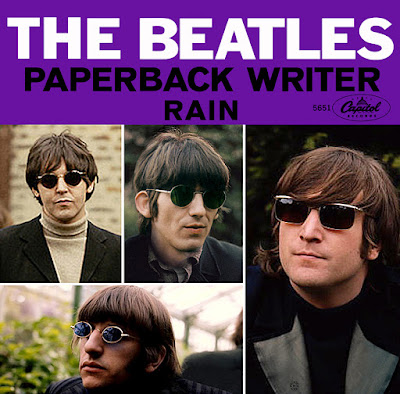
Paperback Writer & Rain


Revolver was the album where The Beatles aimed to record new sounds, and McCartney wanted his new song, Paperback Writer, to sound as rich and deep as the American soul records he admired. "This song is really calling out for that deep Motown bass sound," the Beatles bassist told Emerick. British recordings at that time featured a thin bottom end, and the equipment at Abbey Road was stodgy and the studio's recording rules strict. No easy feat. As the Beatles rehearsed, Emerick reasoned that loudspeakers are simply microphones in reverse, so why not record Paul's bass with a loudspeaker? "Daft," replied a colleague, but sure enough after some rewiring, this experiment worked, and Paul's bass was forever liberated for all to hear in Paperback Writer, its flipside, Rain, and throughout Sgt. Pepper the following year.


Eleanor Rigby

Martin and McCartney agreed that this song needed "biting" strings like Bernard Herman's theme to the Hitchcock film, Psycho. To fulfill McCartney's wish, Emerick broke several rules during the Revolver sessions, a chief one placing microphones literally next to the instruments. Traditionally, an engineered placed one or two mics high above a string quartet, but Emerick put his mics literally an inch from the stringed instruments. "You can't do that, you know," balked one of the session players. Well, he did, and today we can hear the results on one of the greatest Beatles songs and recordings.


Got To Get You Into My Life
Since close-micing the strings on Eleanor Rigby worked, why not try the same approach with the brass on this song? But Emerick contributed something else to this quasi-soul number. McCartney wanted the "brass sound bigger," so Emerick dubbed the recorded horns onto a fresh two-track tape, then mixed it with the original horns just slightly out of sync. Voila.


the bass on the Sgt. Pepper's Lonely Hearts Club Band album
Technical innovation allows performance to flourish. A perfectionist, McCartney demanded more from his recorded bass during these sessions. Emerick boosted the force and presence of McCartney's bass in Revolver, but a new technique during Pepper enhanced its sound. The bass on Pepper is rich and smooth, but does not overpower the vocals and other instruments. Emerick achieved this by moving the bass amp out of the studio baffles and into the centre of the studio, then placed a mic six feet away to capture the ambiance of the room. (What's "ambiance"? Listen to the opening drums of Led Zeppelin's When The Levee Breakss which was recorded in the open hallway of a large country mansion.) Secondly, during mixing Emerick broke tradition by adding McCartney's bass line last, instead of starting off mixing bass and drums (the rhythm) then layering the vocals and other instruments. This approach "sculpt[ed] the bass sound around the other instruments so that you could hear every single nuance." That's especially evident in Giles Martin's brilliant 2017 stereo mix.


Being For the Benefit of Mr. Kite
True, Lennon and especially McCartney were experimenting with tape loops in 1966-7, but Emerick claims he had the idea to cut up tapes of sound effects from the EMI library to create the brilliant circus wash that concludes this song. His inspiration was the few seconds of brass band tucked into Yellow Submarine that came directly from the EMI library. Lennon's original idea was to have a calliope play-out Mr. Kite, but locating this giant instrument quickly wasn't going to happen.


Hey Jude

Here, Emerick was like a relief pitcher in baseball, called in at the last-minute to save a botched mix after The Beatles recorded this landmark song at Trident Studios. Possibly due to a technical fault at Trident, the equalization got botched with Hey Jude missing its high-end. By this time in mid-summer 1968, Emerick had quit the White Album sessions because he was (understandably) fed up with the bickering amongst the Beatles who in turn took it out on the studio staff, including him. (In particular, Lennon was nasty.) By chance, Emerick was at Abbey Road on other business when George Harrison spotted him and begged him to re-equalize the track Emerick did by adding massive amounts of treble.

Geoff Emerick went on to engineer to rest of the Beatles' records in which he employed his innovations in mic placement and mixing. Not him, George Martin or anyone else, but The Beatles pushed the envelope in recorded music during their creative peak of 1966-7, but Emerick was on the team that helped fulfill the band's vision. Emerick deserves credit for that. Generations will admire his studio innovations, which are all the more impressive given the primitive equipment of that period. Emerick himself enjoyed a wonderful career engineering for Paul McCartney, Elvis Costello, Jeff Beck and many others.

Thank you for the magic, Geoff.

Sunday, 30 October 2016

Mark Lewisohn tunes into Toronto


Renown Beatles historian, Mark Lewisohn, recently concluded a three-week research trip to Cleveland (the Rock N Roll Hall of Fame archives) and New York for volumes 2 and 3 of his epic biography, Tune In, by sitting for an interview at Toronto's Metro Reference Library.

An overflowing audience of over 200 heard the Englishman answer questions about the Beatles pivotal year, 1966. After all, his talk was part of the ongoing Beatles 50 T.O. celebration, centering on an exhibition [read the Rowboat's review here] and featuring walking tours, more talks and even a fashion show.

Lewisohn confirmed that the Beatles were first heard in North America on a Toronto radio station, “because Canada has a strong connection to Britain that American doesn't have. Canada tuned into the Beatles before America did."

Here are some more insights Lewisohn offered:


About the Yesterday and Today butcher cover:

This was an attempt by the photographer, Bob Whittaker, who was edgy and liked to do impressionistic work...The Vietnam War is raging by '65/66 and America is deeply involved in it and that is part of the ferment that is going on in this period. It was just a comment, but they obviously could have said, "No, we're not doing that." They didn't. They joined in and did the session.

George never liked it very much, but he did go along with it. John Lennon was the one who pushed for this to be an album cover. There's something extraordinary about a guy who will want something like that as his album cover when you consider that most people believed that the Beatles' core audience was young girls. So, this is a very shocking thing to do, very much in-your-face as we would call it these days. But that's what they wanted.

In Boston there's a swamp filled with 30,000 of these record covers. I was last week in Pennsylvania with a guy who used to work at the Capitol Records pressing factory and his job was to dispose of (I'm not sure) 10,000 record covers. He had to watch them be pulped at a shredding place.


Would Elvis had been asked if he was bigger than Christ or was '66 the year it had to happen?

The times they were a-changing. Everyone was growing up....Through the sixties the audience is maturing. With the Beatles comes an advancement in that maturing process, then others join in like Bob Dylan and the Rolling Stones...


The Beatles were always different in England. When they came here to North America or anywhere they were travelling, they were “on.” They were like working. When they were home in England, their lives were so much different, much more calm and they were always open to reasonable approaches from journalists that they liked. They were interviewed extensively. They had none of the protection that the stars surround themselves with these days. You could phone up the office and say, “I'd like to interview John ideally tomorrow for Sunday's paper." The PR person would phone John and he'd say, “Yeah, okay.”

In this case, Maureen Cleave who was a journalist for the London Evening Standard who they really, really liked – because she was smart and savvy and interesting and witty, and John had a bit of an affair with her once. In 1966, she approached Brian Epstein and said, “I'd like to do in-depth interviews with all four of them and with you Brian, and these will run one a week in the London Evening Standard, whole page. I'll just go over to their houses and we'll talk."

In John's one, he said he was reading a lot, as he always was—he was a voracious reader of books and newspapers—and he just said that the Beatles in a sense were more popular than Jesus, because churches in England in the 1960s were empty....We can get 50,000 people to our shows, and the churches were empty. That in essence was what he was saying. As John said later, he wasn't knocking Jesus for that or boasting that we are bigger, more important. It was just so common. It ran in the British newspapers.

There was one letter in the Guardian about what an interesting remark to make. I'm not sure if that's true, but interesting. And then it went quiet. There were a couple of pieces in America. Funnily enough, there was a piece in a Detroit newspaper in April. The piece ran in England in March, but in July it got picked up by one of the American teenage girls magazines called Datebook.

Datebook put it on the cover: We're bigger than Jesus. And it just kind of sparked. They never held it against Datebook. They liked the editor very much. They kept a relationship with him. [Managing editor Danny Fields, who explains why he published the “Jesus” remark in the video below.] He was on that tour. He was not booted out. He wasn't responsible for the chaos that ensued.


In the new film, Eight Days A Week, Paul McCartney remembered the bigger than Jesus rumpus. What a big story that was for a few days, and says that John was a broken man by it. I'm really cross about that, because John was not a broken man by that. I wish Paul hadn't said that, and it's not right. But on camera that day he chose to say that and they included that, and that's going to be part of the history now. John was never a broken man and John apologized only for the way in which the words were couched or the fact that anybody may have been upset by it. He never actually apologized for what he said.


The second book takes place after 1962. Where are you going to end up after the second volume?

In the asylum, I think.


How are you going to approach this, because a lot of what's happening after December 1962 [where volume 1 ends] doesn't happen in England anymore. How are you going to span the globe and go through all the libraries and dig out this information?

(thinks about it) Yeah. (audience laughs) I'm not quite sure. I've been researching volume 2 and 3 from the beginning. I started this project in 2003. When you do a project like this, the research you just have to find whatever you find whenever you can find it no matter what period it belongs to.

The focus in the earlier years obviously was the early years. I was always finding good things for the next two books. Now, my focus is strictly volumes 2 and 3...

I've been a lifelong lover of libraries and archives and there is a great deal to be found if you know where to look and you have the sensibility for how libraries and archives work. The Beatles' story has the very richest of paper trails. Not just paper. There's every kind of artifact you could ever imagine that is out there waiting to be found. A lot of it is known about substantially, but there is plenty more.

I came away from New York with that [spreads his arms] many original carbon copies of letters from the Beatles' management office from the 1960s, almost every one of which is revelatory, almost every one of which allows me to put real flesh on the bones of a story that people think they know but actually don't, because the tellings of the history tend to haven the sequence of: they made this album, then they went on tour, they made this album, then they made that film, then they went on tour.

What happens in between is as interesting if not more, because I want to make these books – as the first one is – about human beings. I hate the word “icons” or “iconic.” It's overused to death. Or “legends.” The Beatles weren't legends or icons. They were just human beings who expressed themselves this way and found that that was having a major effect without them wishing it on the whole world or substantial part...

I want to tell the story from the inside out, who they were, how they coped with everything that was going on, what their homes lives were like. I'm interested in what happens the day after the tour finishes and they're back home and they need to come down again and start seeing their friends and smoking what they want to smoke. Also, I want to look at it from the outside in, because the Beatles' effect on people everywhere on all ages, colours, creeds, classes was unparalleled.

Hair is the ultimate symbol of revolution in the sixties. It's the ultimate thing to piss off your schoolteacher or parent or factory foreman -- and that was entirely due to the Beatles. It was a revolution and that needs to be told....

I haven't started writing volume 2, and that will take a while, because the assimilation of this material is an immense undertaking, just the structuring of this. I like information and detail in these books, but I don't want the reader to be bogged down in that. I really want this to be a light, engaging, easy page-turner, which is not an easy thing to accomplish with the density of information... 2028 might by when volume 3 comes out, but I might still be researching it. It'll be when it'll be.

Friday, 5 August 2016

The Beatles masterpiece: Revolver or Sgt. Pepper?


For years, Sgt. Pepper's Lonely Hearts Club Band was considered rock's greatest album. In the U.S., Rolling Stone magazine has long ranked it at #1 while Pepper sits in the prestigious Library of Congress' National Recording Registry for posterity. Critics on both sides of the Atlantic first in 1978 then 1987 awarded Pepper the top spot.

Then, Revolver stole the crown. It topped the 2000 Q magazine list of the 50 Greatest British Albums Ever; VH1's greatest albums in history list (2001); the Virgin All-Time Top 1,000 Albums list; and 2013's Entertainment Weekly's greatest albums in history.
1966 ad for the U.S. Revolver

So, what happened?

Probably the tide turned when the 1987 CD issue of the UK version of Revolver finally reached American fans. Since the album's stateside release 50 years on August 8, 1966, American listeners were stuck with an inferior version that omitted I'm Only Sleeping, And Your Bird Can Sing and Dr. Robert. Since 1987, generations have grown up on the complete 14-track album which restores the absence of John's missing songs and rectifies the balance of Revolver.

1967 ad for the U.K. Sgt. Pepper
Further, those GenX'ers and Millennials didn't live through the Summer of Love, which Pepper shaped. Instead, the younger generations grew up with a critical distance and simply listened to the music.

That said, Pepper remains the favourite of many rock and Beatles' fans, but so does Revolver. Below, we (the Doc exhalting Revolver and the Guv championing Sgt. Pepper) debate the merits and weaknesses of both albums.

(Read more about Sgt. Pepper: A Splendid Alternative)

Doc: Sgt. Pepper had the greatest impact of any Beatles -- or rock -- album, but in terms of songwriting, performance, innovation and vision, Revolver is superior. Revolver captures Lennon, McCartney, Harrison and Starr hitting their creative peaks at precisely the same time. They were abetted by an experienced, yet adventurous producer in George Martin, and a hungry, innovative engineer in Geoff Emerick.


Guv: Revolver is the latter part of the Beatles' transition to studio band, but it's still not fully realised. It's patchy. The studio band is still finding its wings. Pepper, on the other hand, stands as a whole. I clearly remember the first time I heard the album as a teen. It blew my mind. As an album, it was greater than its parts and evokes an atmosphere -- a place, a time, a psychedelic, swinging 60s Liverpool.


Poetry & fantasy


Doc: Pepper is an achievement of the highest order, too, but it's an excursion into fantasy and whimsy and not terribly personal or profound, except for A Day In The Life.

Guv: Pepper as an album is more complete, more realized. It's a painting, a watercolour. Revolver is a collage that is best viewed in segments.

Doc: The songs on Pepper are as varied in style and subject matter as those on Revolver, but because the former is packaged as "Sgt. Pepper's band" there's an illusion of unity. It's a collection of songs, that's all, and those songs simply aren't as memorable as Revolver's.

Guv: It wasn't really a concept album, but that's what it is. And it's not just the packaging. The flow of the album is a listening experience. I can dip in and out of Revolver. Pepper is an album I listen to in total.


Doc: The overall flavour of Pepper is self-conscious fantasy, a la Mr. Kite and Lucy and the title track itself. Mind you, the fantasy is dazzling...

Guv: While I agree it's very much fantastical, I don't for a moment believe it's self conscious. Lucy and Kite both have brilliant and creative origins: a child's drawing and an Elizabethan poster - both ideal candidates for songs, and neither is self-conscious. And the instrumentation on those two tracks is highly inventive. Original, stunningly beautiful soundscapes to listen to.

Doc: I find the lyrics on Revolver are more personal and therefore resonant. Pepper is fun, but Revolver touches me.

Guv: Exactly! Pepper is fun. It's not wildly introspective, which is what acid [LSD] did for them, but full of humour and wit. The backing vocal lines in With A Little Help From My Friends. The humour of Lovely Rita ("What do you see when you turn out the lights? I can't tell you, but I know it's mine", "took her home, I nearly made it," & "sitting on a sofa with a sister or two") Nudge-Nudge, wink-wink.

Doc: That's my point: Pepper is indeed fun, more fun that Revolver, but Revolver is grittier. The songwriters began writing introspectively with Rubber Soul, then went full bloom with Revolver, but the acid-Carnaby Street scene pushed John and Paul into whimsy and fantasy.

Guv: Oh, come on! Once again you're picking on Rita and Friends? Just how introspective and reflective do you find Yellow Submarine? And Taxman is just George complaining about how much he had to pay the government. As far as protest songs go, it's hardly Dylan! And what's wrong with Whimsy and Fantasy?

Doc: Nothing, but Pepper is 90% whimsy and fantasy. It needed a personal, poetic song like Strawberry Fields Forever to balance it out.

Guv: Again I come back to listening experience. Put on Pepper and I'm transported. A fantastical world. I can close my eyes and be lost for 43 minutes.

Robert Freeman's dazzling cover for Revolver that was rejected. Freeman photographed the covers of With The Beatles, Beatles for Sale and Rubber Soul. 

The George factor

Doc: One area where Revolver triumphs over Pepper is the diversity of voices. Revolver boasts three George songs and the rest are split between Paul and John. Pepper is overwhelming Paul. You barely hear George. John shines with Lucy and A Day In The Life, but his presence is weaker than usual. I love the contrast of voices on Revolver and miss that interplay on Pepper.

Guv: George shone on Revolver, no doubt. But an album is not about democracy. It's about the best songs at the time. It was a mistake to leave SFF and Penny Lane off Pepper, for sure. I know Paul can be twee (i.e. the verses of Getting Better) but John was there to balance that with, "It can't get much worse." Paul countered this by softening Lennon's seriousness, for example, with his interlude in the middle of A Day In The Life.


Doc: Look at side 1 of Revolver: George's Taxman (an angry song with a funky bassline and a blistering guitar solo), the sad eloquence of Eleanor Rigby with a restrained, but effective classical backing, taking Yesterday a step further), then dipping into psychedelia with John's dreamy ode to daydreaming in I'm Only Sleeping with the backwards guitar. Then, we turn 180-degrees into India with Love You To, which rocks as hard as any Beatles song, only it's done with a tabla and not a Rickenbacker.

Guv: But it's disjointed. It doesn't flow as well. And this is where tone comes in. Revolver works well enough, but as I suggested, by accident.

Doc: My point about Revolver isn't about democracy, but diversity. You have three voices -- and personalities and world viewpoints -- contrasting each other. In Pepper, those viewpoints are glossed over by fantastical songwriting and elaborate musical arrangements. What may be a jumble of songs to you, is to me like reading an anthology of the greatest short stories of all time from cover to cover.

An early version of Klaus Voorman's cover for Revolver before the photo montage.
Guv: Even an anthology of short stories needs a unified theme and flow.

Doc: Revolver flows. The unity lies in the consistent level of musical invention and economical writing of every song. There's no fat on this album and each song is reaching for a new sound and expression. For example, the long, "elliptical" fade-in of I Want To Tell You is seductive and smart.

Guv: Of course there is fat on Revolver. Yellow Submarine belongs there? It's a throwaway, charming kiddie song. Love You To is good, but hardly vital.

Doc: Oh, please,

The Revolver sessions, spring 1966 at EMI Studios on Abbey Road. (photo: Robert Freeman)

Words & music

Doc: The lyrics in Revolver are more personal and the songwriting is economical. Lyrics get to the point and they are sharper. Take any line out of Eleanor Rigby, which is one of Paul's finest lyrics ever ("and was buried along with her name"); or the sardonic Taxman ("If you take a walk, I'll tax your feet"); or the sadly nostalgic She Said She Said ("When I was a boy, everything was right'); or the enigmatic Tomorrow Never Knows ("Lay down all thought surrender to the void"). 

Guv: Those are fine examples, but you can counter those lines with a bunch from Pepper. "And the time will come when you see we're all one and life flows on within you and without you".
  
Doc: Pepper has its moments, lyrically, but they are fewer and far between. "I used to be angry young man, me hiding me head in the sand" in Getting Better is honest and powerful. "See the people standing there who disagree and never win and wonder why they don't get in my door" is a rare instance of Paul talking to himself (a la John). Then, of course, you have A Day In The Life.


Guv: I won't deny Revolver pushed envelopes both instrumentally and in arrangement. It was a huge leap from Beatlemania's boy-meets-girl. But Pepper took it a step further and the studio became another instrument like never before. I would argue that has never been surpassed. Elaborate, textured, layered, but not self-conscious.

Doc: On Revolver, some songs just didn't need elaborate arrangements, like Here There and Everywhere, She Said She Said and Good Day Sunshine. They could have been performed in concert. Pepper songs were all intended for a full production. I can't imagine Lucy in acoustic.


Listen to the isolated tape loops that appear in Tomorrow Never Knows

Guv: Revolver was a band still in transition, from teenyboppers to studio masters. Their minds and imaginations were opened by acid, and they needed to replicate that experience on vinyl. They had time to experiment in the studio, and were fortunate to have willing accomplices in Martin and Emerick. And they did it so well. Revolver is, indeed a masterpiece. But by the time they got to Pepper they had more control, more time (they'd stopped touring) and were able to practise and develop their parts. Paul's playing is more melodic than every before. Revolver took them to the final camp, but with Pepper they reach the top of the mountain.

Doc: The fantasy of Pepper is imaginative and beautiful, but there is a shallowness to it as well. Revolver's songs are more personal and direct, so they touch the listener. Also, there is a diversity of voices on Revolver that is lacking on Pepper. (The Beatles could have rectified this by including Strawberry Fields Forever.)

Guv: That's where Pepper works. It's Psychedelic Music Hall.

Doc: Revolver is a collection of sounds, many new to listeners in 1966, yet still fresh 50 years later. 
There's Indian raga, Memphis soul, Beach Boys harmonies, a children's song, an acid trip and classical strings on an album that has no weak moments.

Read more of our special coverage celebrating the 50th anniversary release of Revolver:

Cos I'm The Staxman: What if the Beatles recorded Revolver in Memphis?

Paperback Writer/Rain: The Beatles' most overlooked single

As relevant as the Vietnam War: the Beatles' butcher cover 50 years later

Beatles 50th anniversary in Toronto exhibition short-changes fans


Tuesday, 26 July 2016

Beatles 50th anniversary in Toronto exhibition short-changes fans


Part of the Rowboat Syndicate's coverage celebrating the 50th anniversary of Revolver

review by Allan Tong

When The Beatles Rocked Toronto is long on Toronto history, but short on the Beatles.
Promoted as "Metropolitan life and music in the mid-60s," the exhibition (running through Nov.12 at the St. Lawrence Market's Market Gallery and part of a larger celebration, Beatles 50 T.O.) does just that. A detailed written timeline, vintage living room furniture, Yorkville coffee house posters, a giant map of the downtown music scene and archival photos detail the vibrant mid-60s scene in Toronto.

This part of the exhibition succeeds. It illustrates uptight, WASPy Toronto invaded by white kids playing folk music and rock 'n' roll. There are mementos of folkies including Joni Mitchell, Gordon Lightfoot and Neil Young who graced the coffee houses of Yorkville, then a hotbed of teen rebellion (and today a millionaire's playground).


A glaring omission is Bob Dylan.

In September 1965, Dylan recruited Ronnie Hawkins' (a legendary Toronto rockabilly singer) band, The Hawks, to back him on his tour. Dylan was transitioning from a folkie into a rock star, and the Hawks (later The Band) would join him. The marriage of Dylan's lyrics with electricity revolutionized popular music in 1965 that directly influenced The Beatles. And Toronto played a key role. So, where's Bob?


This half (literally more than half the floor space of this art gallery) of the exhibition does not connect with The Beatles. True. It's important to offer context so that audiences today can understand the impact The Fab Four had on North American cities like Toronto. However, the Yorkville scene consisted of coffee houses where folk singers played. How did The Beatles fit? The exhibition feels like two separate shows: one about mid-60s Toronto music, and the other about The Beatles' three Toronto concerts in 1964, 1965 and 1966.


Visitors, of course, will pay more attention to the The Beatles' part of the exhibition. There is the requisite memorabilia: a tour program, bobbleheads, trading cards, an oversized comb, a Beatles wig, and a Toronto Telegram magazine picturing John in a ridiculous nightgown on the cover. The jewel is a pristine "butcher" cover. All fun and fine.


More intriguing are Canadian items that few fans have seen: ticket stubs from the Toronto shows, a Cadbury Chocolate offer to buy Beatles photos, CHUM radio station record charts, a rare concert poster, and a Canadian fan club membership card and newsletter. Capitol Canada head honcho, Paul White, contributes much of his own vinyl, including a company newsletter, dated Nov. 22, 1963, declaring "BEATLEMANIA" INVADES CANADA that outlines his record release schedule and strategy. (The exhibit proudly notes that the Beatles conquered Canada a year before the U.S.)

White shares some reminisces in a video that is part of a larger loop. No, there's no footage of The Beatles here, certainly not the concerts or interviews with screaming fans. Instead, there is a Toronto music program that ran on TV. Shamefully, most of this video is marred by out-of-synch audio.

That's right. There's not a single second of film or audio of any of The Beatles' concerts, press conferences or even news coverage (i.e. CBC-TV). Collectors have this already and some of it is available on the internet, but something - anything - deserves to be part of this exhibition. This is inexcusable.

The Beatles play Maple Leafs Gardens, Toronto, on Sept. 7, 1964 (photo: Boris Spremo)
The closest we get to reliving the concerts are two slideshows capturing fans clamouring outside Maple Leaf Gardens, Toronto's venerable, old hockey arena where The Beatles performed, and of the band itself performing onstage and hosting press conferences. Photographers Boris Spremo, John Rowlands and Lynn Ball share many amazing images. Fans scrawl graffiti on the Gardens' back door, and weep and scream in and outside the venue. Watching this, I wondered, What happened to these teenage fans? Where are their reminisces in this exhibit?

Another glaring omission is the complete absence of Revolver. Though the band played no music from this album, the entire point behind the August 1966 tour was to promote it. Similarly, there's zero reference of The Beatles getting fed up with touring and soon winding down Beatlemania. There's no explicit mention of the Bigger Than Christ furor, Tokyo demonstrations and Manila fiasco that forever drove the Beatles, which in turn makes the 1966 Toronto concert all the more important. 1966 forced Sgt. Pepper.  Yet, none of this context is here.

The visitor gets close, but not close enough. When The Beatles Rocked Toronto is a nostalgia trip for Boomers who lived through the era, but they will gain no deeper understanding of The Beatles. Casual fans and those born after the 60s will enter a time capsule and get a taste of Beatlemania and Toronto music, but will not understand the significance of The Beatles on Canadian society. They were a big pop group, that's all.

At $10 admission and supported by the Toronto and Ontario governments, When The Beatles Rocked Toronto is a cash grab. 

Read more about Revolver here.


Tuesday, 21 June 2016

As relevant as the Vietnam War: the Beatles' butcher cover 50 years later

This is the second in a series of features celebrating the 50th anniversary of The Beatles' landmark Revolver album.


In March 1966, two routine events set the stage for The Beatles' annus horribilis: John Lennon's fateful interview with The London Evening Standard's Maureen Cleave where he pronounced "the Beatles are bigger than Jesus," and a routine photo session with Robert Whitaker.

Only it wasn't routine. On March 25, the Australian-born photographer collected The Beatles in a studio in London's posh Chelsea to pose them for a conceptual art piece entitled, A Somnambulant Adventure.

"I felt The Beatles needed a new approach with their image," Whitaker explained in The Beatles: An Oral History. Whitaker got George to pretend to hammer nails into John's head, each of them to wear bird cages over their heads and all of them to hold a strand of sausages. Whitaker got more carnivorous by draping the band in white butcher smocks and throwing slabs of raw meat and dismembered plastic dolls over them.

Fifty years later, it's not entirely clear how the infamous butcher image wound up on the cover of Yesterday and Today, but it sounds like the band (probably except George who detested the images) submitted the butcher photos to EMI and Capitol to promote their next releases, including the June 10 Paperback Writer single in the UK.


This ad first appeared in the New Music Express in the last week of May 1966, then on June 4 in Disc and Music Echo ahead of the June 10 release of Paperback Writer/Rain. A week later, the same magazine printed a colour photo on its cover, an alternate image beneath the headline, "What a carve-up!" The image raised a few eyebrows in Britain, but nothing more.

However, when the first printing of Yesterday and Today hit American records stores on June 20, it unleashed a firestorm and we all know what happened next: a costly, massive recall that resulted in unknown quantities of a generic cover slapped over the offending butcher cover, thus instantly rendering those copies collector's items.

"The original cover concept never really materialized," explained Whitaker. "It was meant to be a double-folded album cover where the front showed the four Beatles holding sausages, which would have stood for an umbilical cord." The link of sausages would connect with a woman in the inside gatefold to symbolize the birth of the Beatles and "all kinds of surreal, far-out images."

Well, that would have been different. Regardless, Whitaker was surprised that the butcher cover wound up on the front of Yesterday and Today and wonders if The Beatles sent Capitol the butcher image as a dark joke for this "filler" album.

In the valley of the dolls. Robert Whittaker's fateful photo shoot with The Beatles begins.
It ends in either black humour, poor taste or a protest against Capitol Records.
If 1967 was the Summer of Love, then 1966 was the Summer of Hate. At least, for The Beatles. The year began pleasantly enough with the band getting an overdue rest after three non-stop years of work before recording Revolver in the spring. Three songs were pulled from the early sessions to pad out yet another hodgepodge that Capitol presented to Beatles' fans as their so-called "new" album.

Let's consider Yesterday and Today, which was released 50 years ago today. Sure, it's full of great songs, including Nowhere Man, Day Tripper, We Can Work It Out and the title song, but the collection is disjointed and ultimately unsatisfying. Stylistically, songs jump from the country-and-western Act Naturally and What Goes On to the psychedelic I'm Only Sleeping and the heavy guitars of And Your Bird Can Sing and Day TripperYesterday and Today also suffers from an imbalance of voices: Paul sings lead on only three of the 11 songs, Ringo takes two, George gets one, and John the rest. If anything, Y&T is a survey of John Lennon's songwriting from 1965-6.

Capitol got away with this tawdry re-packaging in Something New and Beatles VI in 1964 and 1965 because the Beatlemania sound was homogenous over this period, but Y&T captures the Beatles in a period of rapid maturity. Only 12 months separate the releases of Help! and Revolver, but artistically The Beatles traveled light years in this time. Can you imagine Act Naturally on Revolver?

To be fair, every British Invasion group, including The Rolling Stones and Animals, suffered the same crass re-packaging of their music that routinely short-changed American fans (UK albums boasted 14 songs and no singles). Y&T was especially egregious. Yesterday, Act Naturally, We Can Work It Out, Day Tripper, Nowhere Man and What Goes On were already selling as 45s in American record shops when Y&T landed on June 20, 1966. That means that less than half of the album's music was actually new. Of course, Capitol didn't care. Y&T sold 500,000 copies in two weeks, and topped the charts for three weeks.

In 2016, Yesterday and Today is largely a nostalgia piece for North American baby boomers and a curio for later generations. Yesterday and Today symbolizes a pop band that suddenly outgrew its teenybopper image and was rapidly reshaping music. The butcher images that promoted the album and Paperback Writer were meant to sever the band from their cute moptop image. Sgt. Pepper would accomplish that with more subtlety and imagination 12 months later.

In 1986, the butcher cover re-appeared on official vinyl as the B-side of the limited-edition Paperback Writer picture disc. In 1980, it graced the gatefold of the North American release of the Rarities LP.

On a more important level, the butcher cover was the first of several controversies in 1966 that culminated in The Beatles retreating from concert stages forever and retiring Beatlemania for good. The Beatles were never the same after the summer of 1966.

They were a sardonic, cynical bunch, and the symbolism of peeling back the innocuous moptop image of Yesterday and Today to reveal the hidden butcher cover beneath is obvious. The mood of the era was darkening, too. By 1966, America was falling deeper into the amoral Vietnam War while its Civil Rights Movement was growing bloodier with riots and demonstrations.

The butcher cover, sneered Lennon was "as relevant as Vietnam."

Tuesday, 31 May 2016

Paperback Writer/Rain: The Beatles' most overlooked single

This is the first in a series of features celebrating the 50th anniversary of The Beatles' landmark Revolver album.

Innovative in sound and lyric and influencing rock bands decades after its release 50 years ago today, Paperback Writer was the first Beatles' single to be greeted by disappointment.

It was the first single since She Loves You to fail to immediately hit #1 upon release, though it would covet the top spot for two weeks on both the U.K.'s New Musical Express and American Billboard charts. Critical reaction was mixed. In 1974, British music critics, Roy Carr and Tony Tyler, wrote that "opinions still differ as to the merits of Paperback Writer, the first Beatles single to receive less-than-universal acclaim."

Today, that's astonishing to read, but then again, Paperback Writer and its brilliant b-side, Rain, are considered two songs created well ahead of their time.


Can you hear me?

A few weeks into the Revolver sessions on April 14, 1966, Paul McCartney strolled into the EMI Recording Studios on Abbey Road, sat at a piano and confidently declared to his bandmates, "Gather 'round, lads, and have a listen to our next single."

Paul then pounded out a catchy tune about a wannabe writer, and directed John and George where to harmonize. "It was obvious to everyone in the room that this was an instant hit," engineer Geoff Emerick recalled in his memoirs, Here, There and Everywhere.

Artistically, both sides of the single broke from the traditional boy/girl lyric found in all previous hits, including the Beatles' recent We Can Work It Out/Day Tripper. Trite love songs still ruled the charts (and still do today), but by mid-April 1966, Bob Dylan had revolutionized popular songwriting with his 1965 albums, Bringing It All Back Home and Highway 61 Revisited, which burst with abstract images and symbolist poetry. No love songs here.

Paperback Writer would be Paul's first "story" lyric, where he tells a tale in the third person, namely about an aspiring writer whose son works for the Daily Mail and wants to get a novel published. Paul delivers a sharp vocal, but the highlight is the refrain, sung in harmony with John and George and drenched in heavy echo.

Sonically, Paperback Writer also boasts a gorgeous, fat bass line that was inspired by American soul records from Stax and Motown. The bottom end never sounded like this on any Beatles' (or British) record to this point. The Beatles were tired of hearing superior bass on American records and demanded a change. "Pull out all the stops," Paul instructed the band's new recording engineer, Geoff Emerick. "This song is really calling out for that deep Motown bass sound."


Long technical story short, Emerick experimented by wiring a loudspeaker as a microphone to max out Paul's bassline, which, by the way, he was playing from a beefy Rickenbacker instead of his "thinner" Hofner violin bass.

Paul also played the fuzzy lead guitar (though some believe it was George) which was also the Beatles' first distorted guitar. 1966 Beatles is noted for this sound which reflects the music their peers were making from London to San Francisco. Paperback Writer as well as Rain owe more to the Yardbirds' hit of the previous summer, Heart Full of Soul, than the clean twang of I Want To Hold Your Hand. The Beatles did not invent this sound, but helped popularize it.

 
The same goes with the b-side, Rain, which was every bit as inventive as the a-side, but decidedly less commercial. It's widely considered the band's finest b-side, though in my book, it's really on equal footing with Paperback Writer, like We Can Work Out complements Day Tripper. 


This Lennon track owes an obvious debt to the Byrds, the California band that was in turn influenced by The Beatles' 12-string Rickenbacker sound. However, the lyrics, which were definitely not boy/girl, were inspired by LSD that John was starting to drop regularly around this time.

Studio trickery here amounted to slowing down the rhythm track to make it sluggish and playing the vocals in the fade-out backwards. Though George Martin took credit for this innovation, it's more likely (as corroborated by engineer Emerick) that John got stoned on hash one night and accidentally spooled his reel-to-reel tape backwards on his home deck. The sound blew his mind.

The song creates a dazzling, colourful world of its own that the listener can slip into for three minutes, like Alice tumbling down the rabbit hole. However, the sound texture of Rain would've been too far out for 1966 radio, and for years it was a nearly-forgotten gem.


In the digital age, Rain finally gotten its due. Until 1987, the track was not featured on any album, including compilations, and found only if you picked up the Paperback Writer single. Even then it was mixed only in mono. However, I would argue that the wide-panning stereo on today's releases it terrible. Ringo's high-hat is to loud in the mix, and the stereo picture is too disjointed with vocals and instruments separated by a thousand sonic miles.

A word about Ringo's drumming. Ringo himself feels that Rain features his best drumming, but I disagree. His shining moment came a few weeks later in mid-1966 when The Beatles recorded She Said She Said.


I can show you
Paperback Writer/Rain was a preview of their forthcoming album, Revolver. I suspect that few fans realized it at the time, but The Beatles in June 1966 were searching for new sounds and tired of their cute moptop image. Like all great artists, The Beatles were too talented to stand still. Sure, their records would continue to sell millions and top the charts, but who was really listening? Unlike She Loves You which launched The Beatles in 1963 Britain or Hey Jude which would become their biggest-selling single, Paperback Writer/Rain would be overlooked in its time and not fully appreciated until many years later for its originality and innovation.


Monday, 9 November 2015

13 Beatles Deep Cuts

The Urban Dictionary defines a deep cut as as: "A song by an artist that only true fans of said artist will enjoy/know. True gems that are found later in an album, a b-side. Rarely if ever played on the radio."

The Beatles are perhaps the most widely played band of all time. Yet, there exists a handful of songs, buried on albums and B-sides that are hardly ever played on the radio nor appear on compilations--but should be. We at Rowboat Syndicate unearth these gems here: 


IT WON'T BE LONG (With The Beatles)
John's charging vocals set against a breakneck tempo launch the album that heralded Beatlemania. The "yeah yeah" backing vocals of Paul and George echo She Loves You which, along with moptops and collarless jackets, were hallmarks of Beatlemania. Indeed, With The Beatles was recorded in the summer of 1963 while She Loves You was riding atop the British charts. It Won't Be Long is the perfect album opener, bursting with infectious energy, a galloping backbeat and exuberant harmonies. This is the sound of a hot, confident band on the rise--and knows it.


THINGS WE SAID TODAY (A Hard Day's Night)
John was white-hot during the first flush of international Beatlemania, being the lead writer of 10 of the 13 songs on the album, A Hard Day's Night, but Paul made up for his lack of quantity with quality. Buried on side two of the original UK LP, and relegated to the B-side of the UK single of AHDN, Things We Said Today is an uptempo ballad marked by a strong guitar riff which grounds the song. Paul's vocal is cool yet assured, while the arrangement (vaguely Latin) runs against the typical love song and amounts to sounding like nothing else in the early Beatles period or this era for that matter.


I'M A LOSER (Beatles For Sale)
 Much has been said about the lyrics of this song, marking a maturity in Lennon's songwriting (as inspired by Bob Dylan), and deservedly so. It's the best song on Beatles For Sale, the band's weakest album, but I'm A Loser foreshadows the introspection found in the following summer's Help! single. While Rock and Roll Music and Eight Days A Week have appeared on compilations, the album's best song, I'm A Loser remains solely on Beatles for Sale.


YOU WON'T SEE ME
I'M LOOKING THROUGH YOU
(Rubber Soul)
The Beatles could have released half the songs off this album as singles, including these two anti-love songs. Paul wrote them during a difficult patch with then-girlfriend, actress Jane Asher. They're both upbeat, rythmic numbers, the former inspired by the Temptations, which only underlies the anguish of the lyrics. "When I call you up, your line's engaged / I have had enough, so act your age," sings Paul in You Won't See Me while in I'm Looking Through You, Paul declares that, "Love has a nasty habit of disappearing overnight." Solid vocals, catchy melodies and lyrics with bite make these two album tracks highlights on an album bursting with masterpieces.


SHE SAID SHE SAID
TOMORROW NEVER KNOWS
(Revolver)
Revolver boasts such depth of songwriting, arrangment and performance that several of its songs qualify as deep cuts. How to choose? These two Lennon tracks, which close side A and B respectively on the original long-player, showcase a new direction in Lennon's songwriting. The songs reflect on mortality and mysticism. Also, they were directly shaped by acid trips.

She Said She Said is a direct lift from Peter Fonda recounting a near-death experience he has as a boy when he shot himself. He imparted this George to guide him through a rough LSD trip, while The Beatles were visiting Los Angeles in the summer of 1965. Lennon overheard Fonda's morbid anecdote and was repulsed by it. In other words, Peter Fonda is the "she" in She Said She Said. However, there's a melancholy in the song's "middle-eight" that anticipates the childhood retrospection of Strawberry Fields Forever: "When I was a boy / Everything was right." It's a mystery why Paul didn't play on this track, apart from having an arguing (over what?) and storming out of Abbey Road, but the remaining three Beatles play marvellously on this track. I personally consider Ringo's drumming on this song his best among all the Beatles recordings.

Tomorrow Never Knows is, of course, the album closer that paved the way to Sgt. Pepper. It's a song built on one chord and coloured with sound effects galore. The Beatles were infiltrating pop music with the avant-garde. The song stunned many at the time, but has never aged.

It astounds me that neither song has been included on various greatest hits compilations over the years, namely 1962-66. You will find them only on Revolver, arguably the band's greatest album.


RAIN (B-side, Past Masters 2)
To my ears, Rain and Paperback Writer are a double-sided single that rivals their previous and forthcoming UK singles, but Rain has never received the attention paid to its more popular flipside. Rain sounded too experimental for the pop charts of 1966, particularly its brilliant backwards coda. Paul's deep bass, Ringo's stuttered drumming and John's distorted vocals blend into a multicolour pastiche that shimmers whenever you listen to it. Rain is an amazing audio experience and remains as fresh as the day it was released in mid-1966. Until the CD age, Rain was available only on the Paperback Writer single. Again, why the hell wasn't it included on 1962-66 or the Hey Jude compilation of 1970? 


DEAR PRUDENCE
BLACKBIRD
HAPPINESS IS A WARM GUN
LONG LONG LONG
(The Beatles)
Let's face it: The White Album is one long deep cut. By decreee, none of its 30 tracks was released as a single in the U.S. or U.K. (though Ob-La-Di, Ob-La-Da was paired with While My Guitar Gently Weeps in a few smaller markets). The quality of album's songs varies wildly, but a handful stand above the others.  

Dear Prudence is a ballad, like Hey Jude, that builds in tempo and dynamics until it climaxes into a burst of sound and emotion. Both Prudence and Blackbird feature the debut of fingerpicking guitar-playing that Donovan taught the Beatles in India in early-1968. Blackbird is Paul's ode to the black Civil Rights Movement. Remember, this was the year Martin Luther King was assassinated and American cities were rioting. Featuring just Paul on acoustic, Blackbird is simple, direct and transcendent.

By contrast, Happiness Is A Warm Gun is one of The Beatles' most complex songs, featuring another abstract Lennon lyric ("lying with his eyes while his hands are busy working overtime"), three distinct sections and several changes in tempo and instrumentation, all remarkably done in 160 seconds. The other Beatles nominated this the best song on the White Album and I wouldn't argue with that.

George began to blossom as a songwriter during this period. While My Guitar Gently Weeps gets all the attention, but this hymn-like ballad that closes the boistrous third side is moving. He could be singing about a lover, but really George is talking to God. He's finding spiritual peace and opening doors to higher levels of consciousness without being preachy (as he was in his solo career). This added layer gives Long Long Long a powerful, yet understated depth.


BECAUSE (Abbey Road)

Though Paul dominates Abbey Road, John contributes some key moments. Because is one of them. It's really a reworking of Beethoven's Moonlight Sonata, but the song's spare, hypnotic arrangement and intricate three-way harmonies by John, Paul and George elevate it into a masterpiece. The spare lyrics, directly influenced by Yoko Ono, read like Zen philosophy and perfectly suit the spare arrangement: "Love is old, love is new / Love is old, love is you."

Wednesday, 16 September 2015

The 10 best Beatles basslines

Nobody wanted to play bass in The Beatles. John, Paul and George wanted to play lead or rhythm guitar. Bass wasn't sexy. You couldn't "pull the birds" plucking a bass. So, in the early days in Hamburg, Stuart Sutcliffe (below with George) was stuck with the instrument after his bandmates urged the gifted painter to spend his winnings from an art competition to purchase a Hofner 333.
 After all, somebody needed to provide the band with a bottom end as they rocked the stages of the Kaiserkeller and the Top 10. After Stuart left The Beatles in July 1961, he passed his Hofner to a reluctant Paul who eventually bought his own bass.

 Today, we identify Paul with his violin-shaped Hofner and adore his exceptional playing on so many songs. (But let's not forget George subbing for Paul in a few exceptions, such as She Said, She Said.) Here, in our humble opinion, are the ten finest bass lines in The Beatles' canon:

Click each song title to hear the isolated bass track of that song.


Though John and Paul wrote the lead-off song to Rubber Soul, George suggested that the band play the lead and bass guitars almost in unison, directly influenced by Donald "Duck" Dunn's stellar bass performance on Respect by Otis Redding which was charting in mid-1965. After the lead guitar opens the song, George lays down an unmistakably funky bass line that lets the other instruments and Paul's vocal fall into a solid groove.


http://www.thebeatlesbutchershop.com/ 
Revolver showcases Paul's bass like no other album before or after. There are four reasons why the bass sound is so rich on The Beatles' seventh album: Motown's influence (its legendary session bassist James Jamerson), Stax Records (Donald "Duck" Dunn), Paul's new Rickenbacker 4001S bass, and Geoff Emerick. Emerick became The Beatles' recording engineer at Abbey Road, the guy in the white lab coat who placed the mics around the instruments and twiddled the knobs on the recording console. "I was getting frustrated listening to American records like the Motown stuff," recalls Emerick, "because the bass was a lot stronger than we were putting on our records." Emerick remedied this deficiency by basically turning a studio speaker into a giant microphone to capture Paul's monster bass lines (the technicals are detailed in Emerick's memoirs, Here, There and Everywhere). Listen to the mono version of Revolver and the Paperback Writer/Rain single. The songs rival James Brown in sheer heaviness in the bottom end. Paul deserves full credit for the infectious bass line that grips Taxman. It's perhaps the most recognizable bass line in the Beatles' catalogue and was good enough for Beck to copy in The New Pollution 30 years later. Paul's bass dominates Paperback Writer and Rain so thoroughly that the needle nearly jumps off the grooves of the vinyl on your turntable. Both the released and alternate versions (right channel of take 2) of And Your Bird Can Sing showcase Paul's melodic bass lines.

It's hard choosing one song off Sgt. Pepper that demonstrates Paul's bass-playing prowess. The recording process on this album was a little different, in that Paul laid down his bass part last, after the rest of the instruments and vocals were recorded. This perspective afforded him the opportunity to shape his basslines which were invariably melodic yet meaty. Lovely Rita and A Day In The Life also feature outstanding work by Paul.

The track that benefits the most from the 1999 remixes of The Yellow Submarine Songbook CD is Hey Bulldog. The old extremely panned stereo mix spreads the rhythm section paper thin, but the bold new remix concentrates the drums and bass, propelling those intruments to the front of the stereo picture. Ringo's drums and Paul's bass leap out the speakers like never before. Paul's fills between John's verses are full of swagger and attitude.

Credit Paul for taking John's original up-tempo Chuck Berry rocker, slowing it down considerably and adding a swampy bass lick. Like Rubber Soul, Abbey Road opens on the bass and carries the song all the way through. In the long fade out, Paul's fluttery notes over Billy Preston's organ solo is outstanding.

This bassline divides listeners: it's either too busy, threatening to distract from George's vocal, or it sweeps you in a melodic tour-de-force. I'm of the latter, and love the interplay during the guitar solo between George's guitar and Paul's bass.

To be fair, this experimental heavy rock song showcases all of the Beatles' guitars and not just Paul's bass. Like so many Beatles songs, the bass in I Want You (She's So Heavy) not only provides the bottom end, but acts as a lead guitar as well. There's as much melody in the bass as in John's rhythm guitar or George's lead.

Wednesday, 26 August 2015

The Stoner's Guide to The Beatles

"I think everybody's mind should be bent once in a while," said Bob Dylan in the mid-1960s. Dylan was the King of Folk on August 28, 1964 when he bent the minds of the Fab Four in their suite at the Delmonico Hotel in New York. Dylan, let's remember, was coming from the Greenwich Village folk scene of the early-1960s which was inspired by the reefer smokers of the Beat movement.

PLEASE PLEASE ME / WITH THE BEATLES / A HARD DAY'S NIGHT / BEATLES FOR SALE / HELP!

Possibly, The Beatles toked up when they cut their teeth in Hamburg between 1960-62, but if they did, it didn't affect them until Dylan sparked that fateful phattie. Most of the Beatlemania era is pretty "straight." Beatles' lyrics were about girls and love (like everyone in the top 30), and the arrangements were straightforward rock 'n' roll with a few ballads.

That said, a few songs from the Beatlemania era rock under the influence. I Feel Fine kicks off with shrieking feedback that'll blow your mind (and which helped pave the way for the distorted guitar of Jimi Hendrix), and Ticket To Ride, whose chiming guitars betray an Indian twang. In both songs, the guitars mesmerize the listener through your speakers or headphones. It's no secret that the band at this time was smoking pot "for breakfast," recalled John Lennon, and it's effect may have seeped into Ticket To Ride.

On a general note, the American Capitol mixes drenched in echo sound better to stoners than the dry EMI mixes. Echo sounds great when you're stoned. Listen to Roll Over Beethoven on The Beatles' Second Album where the reverb will blow your mind, then compare that to the the dry mix on With the Beatles where George's guitar sounds like an elastic band.


RUBBER SOUL
Instead,it took a full year for the creative and psychological effects of grass to affect visibly appear in their music. By the release of Rubber Soul in December 1965, John, George and Ringo (and to a lesser extent Paul) had tripped on LSD, which who colour Revolver the following summer.

The first clue is the album cover: stretched, distorted faces. The moptops are daytripping.
Most of the songs are still about girls, but the lyrics of Norwegian Wood, Girl and In My Life shimmer with symbolism and imagery. Nowhere Man doesn't even talk about love but alienation and identity. These weren't dance songs, but head songs. Music to make you think.

Sonically, too, the band was exploring. George's sitar in Norwegian Wood adds a new texture to the Beatles sound. The funky bass line in Drive My Car is a stone groove. I'm Looking Through You sweeps the listener away with its stabbing accordion notes and driving acoustic guitar.

And this is just the start.


REVOLVER


The dazzling original cover by photographer Robert Freeman.
Revolver is dipped in LSD. You first hear it in the Indian-like twang of Paul's searing guitar solo in Taxman; then in the sluggish, backwards guitar and sped-up John vocal of I'm Only Sleeping; George's Indian showcase of Love You To; the hard, trebly guitars of She Said, She Said and And Your Bird Can Sing; Paul's recounting his pot experience (always a step behind the others in substances) in Got To Get You Into My Life; and of course the stunning album closer, Tomorrow Never Knows which details an acid trip with lyrics lifted from the Tibetan Book of the Dead and LSD guru Timothy Leary.

Never before was there this much distorted and manipulated music on a Beatles record. Add to this the single that was recorded during these spring 1966 sessions, Paperback Writer and Rain, which featured heavy guitars, deep echo, backwards vocals and sluggish drums.


Start listening, though, with take one of Tomorrow Never Knows found on Anthology 2. It's stripped down and distorts John's voice so much he sounds like he's singing from another galaxy. This is one of the overtly druggiest songs in the entire Beatles cannon. Start here and float downstream...


SGT. PEPPER'S LONELY HEARTS CLUB BAND

An obvious choice. Pepper is the signature psychedelic album by The Beatles and from that era (which included the debuts of Hendrix and Pink Floyd, and Cream's Disraeli Gears).

The elaborate soundscapes are meant to take listeners on a journey with each song evoking a different feeling. John's songs are particularly trippy, Lucy in the Sky with Diamonds and Being For the Benefit of Mr. Kite. No surprise, since he was dropping almost every day, as he revealed later.

However, Paul sets the album's tone with the title song featuring the hardest guitars heard on a Beatles album up to that point.

Other highlights include George's Within You Without You which features an extended duel between Western orchestral instruments and classical Indian ones that sounds hypnotic.

The most impressive song, of course, is the closer, A Day In The Life, which features a haunting Lennon vocal, sharp tempo changes, two orchestral rushes and a 42-second multi-tracked piano chord that sweep the listener through a harrowing five-minute sonic journey. The song remains the towering achievement in The Beatles career.


MAGICAL MYSTERY TOUR
Really a soundtrack of the TV special mixed with the two singles from 1967. The MMT tracks are mediocre by the Beatles' lofty standards, but Fool on the Hill is a beautiful yet delicate ballad and I Am The Walrus is a brilliant yet chaotic acid trip, exploding with absurd imagery wrapped in a Dadaist soundscape.

Strawberry Fields Forever and Penny Lane represent a peak in songwriting and sound construction. They aren't so much songs but music collages that evoke vivid images and the whole gamut of emotion from melancholy to joy.


THE BEATLES (THE WHITE ALBUM) 


Photographed by Richard Avedon, 1968
There's a casual feel to this 95-minute sprawl that contrasts with the albums of 1966 and 1967 that took listeners on a trip. You need need to play The White Album from start to end. You can stop and start The White Album and jump around songs. The album was mostly written on acoustic guitars and overall offers a laid-back feel. One song doesn't melt into another as found on Pepper. For stoners, the rock songs should be heard in mono where they offer more punch than the stereo mixes. Also, the electric guitar shines on this album after being largely absent from the Pepper era. Highlights: Dear Prudence, While My Guitar Gently Weeps, Happiness Is A Warm Gun, side 3 and Revolution 1.


ABBEY ROAD


The last recorded album is the band's most modern-sounding and polished. Again, the electric guitar rules, and Paul's bass playing has never been as fluid. You hear this excellent marriage of Lennon's biting vocal and Paul's swampy bass on Come Together, a powerful rocker. A wall of guitars drive I Want You (She's So Heavy) and a three-way duel propels The End.

However, the Zen-like arrangement and beautiful harmonies of Because are heavenly. One of the best stoner songs by anybody. All of side 2 starting with Here Comes The Sun must be listened to in order as the momentum rises with each song fragment and sweeps away the listener.


 LET IT BE
  

This patchwork album offers a few gems for stoners. Across The Universe evokes the heavens in its lyrics and symphonic backing. Let It Be sounds sacred under the influence. I Me Mine features a biting guitar. The Beatles sound like a cool bar band in the Apple rooftop songs I've Got A Feeling and Get Back.